
7.1 Introduction
Grinding is a metal removing process performed with the help of grinding wheel. It is employed for finishing various parts, such as engine crankshafts, splined shafts, lathe guide ways, long pipes, worms, toothed gears, pinions, racks, and surfaces. The various operations performed on grinding machines are
- Grinding flat surfaces
- Cutting off blanks
- External and internal cylindrical grinding
- Tapered and complexed surface grinding
- Gear tooth grinding
- Screw thread grinding
- Cutting tools grinding
These days grinding is used mainly for the following purposes:
- To remove a small amount of metal from workpieces and finish them to close tolerances
- To obtain a better surface finish
- To machine hard surfaces that cannot be
- machined by high-speed steels
- Sharpening of cutting tools
- Grinding of threads
- Sometimes it is used for removing bigger stocks of metals.
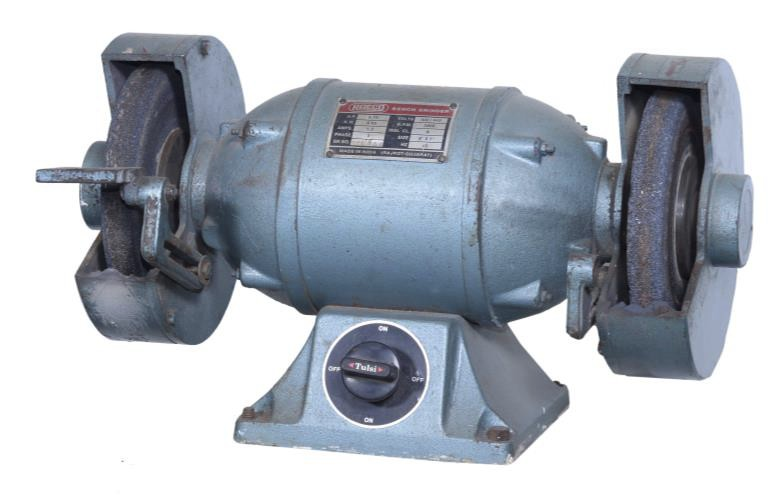
Fig. 7.1 Bench grinding machine
Abrasives used for making grinding wheels are very hard, have poor heat sensitivity and can thus be used at high speeds. The biggest advantage of grinding wheels is their self-sharpening
property.
7.2 Manufacture of grinding wheels
The manufacture of grinding wheels involves the following steps:
- Ascertain the purity of the abrasive.
- Crush the abrasive into small particles.
- Again remove the impurity
- Sieve the particles to the required size.
- Mix the abrasive particles with a calculated amount of bonding material.
- Pour the materials in moulds, press and dry.
- After drying, bake the moulds by heating to a suitable temperature.
- Cut the mould to the required shape and size.
- Inspect the component and test for proper working.
7.3 Marking system for grinding wheel
IS: 551-1966 lays down the rules for the marking system of grinding wheels. The marking system comprises seven standards. These are:
Manufacturer’s symbol
- Type of abrasive
- Grain size of abrasive
- Grade of abrasive
- Structure (optional)
- Type of bond
- Identification mark (optional).
The grain size of a grinding wheel varies from 8 to 600. 8 denotes the coarsest grain, while 600 denotes the finest.
The type of bond is designated by the following letters
V – Vitrified
S – Silicate
R – Rubber
RF – Rubber reinforced
B – Resinoid (synthetic resin)
BF – Resinoid reinforced
E -Shellac
Mg – Magnesia
7.4 Specification of grinding machine
The specification of bench grinding machine manufactured by RAECO. Rajkot, India, is given as below:
Table 7.1 – Specification of grinding machine manufactured by RAECO
Description | Dimension |
No load speed | 2800 rpm |
Wheel diameter | 8 inches |
wheel thickness | 1 inch |
Arbor hole | 5 / 8 inch |
Motor | 0.75 H.P. |
ACTUAL JOB PHOTOGRAPHS